Attack surface management matters because modern Azure environments change faster than most security processes can keep up with. New endpoints, workloads, identities, APIs, integrations, and data paths appear continuously. If teams only rely on periodic reviews or disconnected tools, they end up with an incomplete picture of exposure and too much noise to act on quickly.
That is where TENET’s attack surface capability is designed to help. Instead of treating exposure as a flat list of findings, TENET helps Azure teams understand which exposures are reachable, which ones create meaningful business risk, and which ones should be fixed first.
The problem is not just visibility
Most organizations already have security signals. They have vulnerability findings, cloud posture alerts, IAM reviews, monitoring events, and compliance reports. The problem is that these signals often live in separate places and are reviewed in separate workflows.
That fragmentation creates three familiar problems:
- Teams can see issues but cannot easily tell which ones are actually dangerous.
- Risks involving identity, data access, and network reachability are hard to connect.
- Ownership is often unclear, so remediation slows down even after a problem is found.
Attack surface management should solve more than discovery. It should help teams answer practical questions such as:
- What is exposed?
- What can an attacker reach from there?
- Which combinations of risk create real impact?
- Who should fix it?
TENET is built around those questions for Azure-first environments.
What TENET’s attack surface capability is built to do
TENET gives teams a context-driven view of their Azure attack surface by combining asset exposure, risk signals, identity relationships, and business relevance into one workflow.
Rather than stopping at internet-facing discovery, TENET brings together signals from multiple Azure data sources to create a more complete picture of risk. This includes infrastructure visibility, identity context, network exposure, anomaly indicators, compliance evidence, and asset criticality.
The result is not just an inventory of exposed assets. It is a working model of which attack paths deserve immediate attention.
1. Discover the Azure assets that shape real exposure
An effective attack surface program starts with discovery, but discovery in Azure is more complex than simply scanning known domains. Teams are dealing with app services, virtual machines, APIs, storage endpoints, key vaults, role assignments, managed identities, and temporary workloads that can be created or changed in minutes.
TENET helps centralize visibility across the Azure environment so teams can see the assets and configurations that contribute to exposure. That matters because many of the most important risks do not come from a single asset being public. They come from how that asset connects to permissions, sensitive data, and downstream systems.
For Azure teams, that means an exposed service should never be judged in isolation. The real question is whether it is exposed and privileged, exposed and connected to sensitive resources, or exposed and part of a lateral movement path.
2. Add the cloud context that separates noise from risk
This is where many traditional approaches break down. A list of public endpoints or misconfigurations may be useful, but it does not tell a team what matters first.
TENET’s attack surface capability is designed to add context to each exposure by correlating multiple dimensions of risk, including:
- Resource criticality
- Identity permissions and role assignments
- Network exposure
- Vulnerability and misconfiguration signals
- Compliance status
- Active anomaly indicators
This is the difference between theoretical risk and operationally meaningful risk. A public-facing workload with limited permissions may still need attention. A public-facing workload tied to excessive privileges or a path to sensitive data deserves immediate action.
3. Map attack paths instead of reviewing isolated alerts
One of the most useful parts of attack surface management is understanding how an attacker could move from initial access to something more damaging.
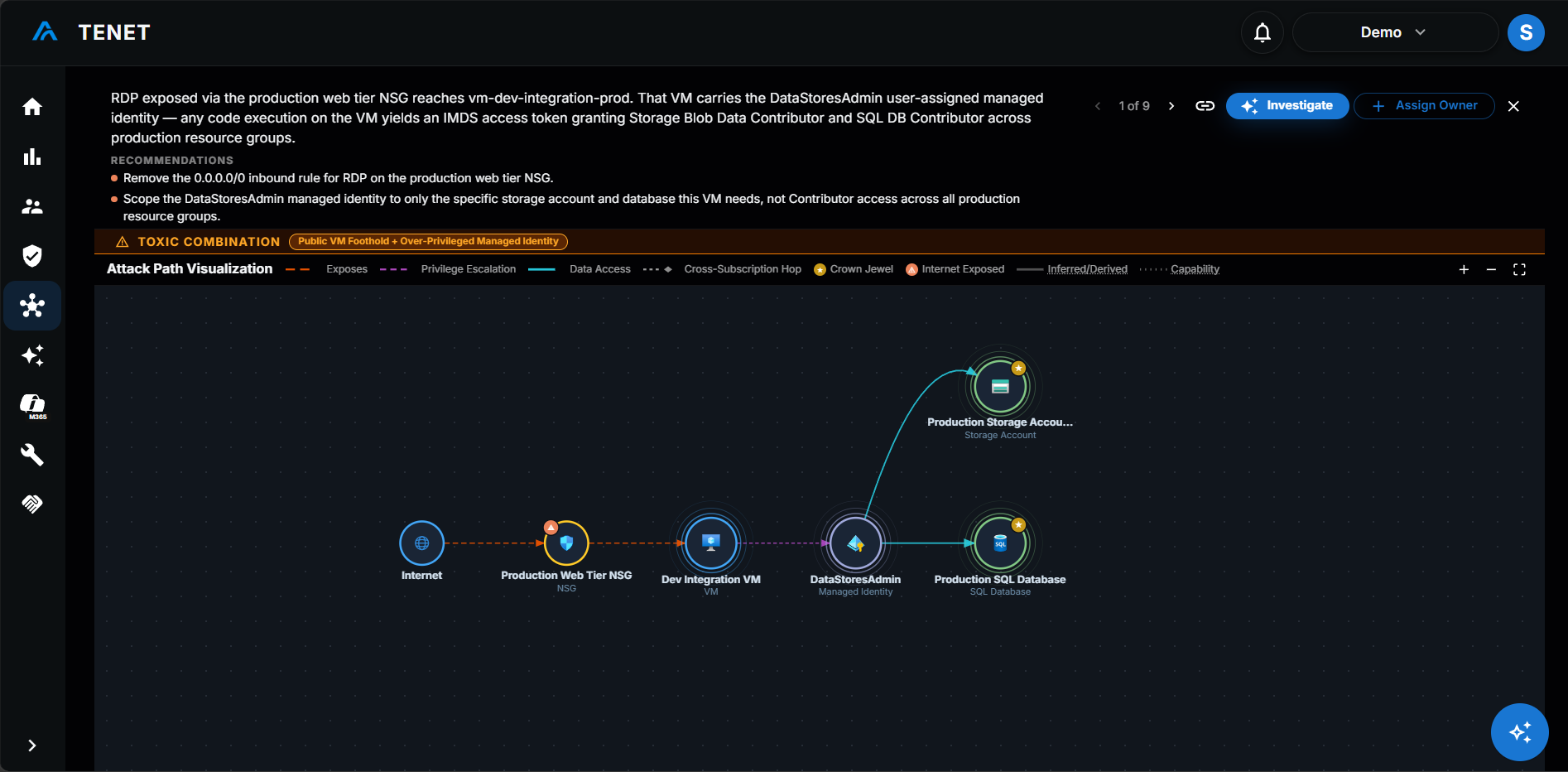
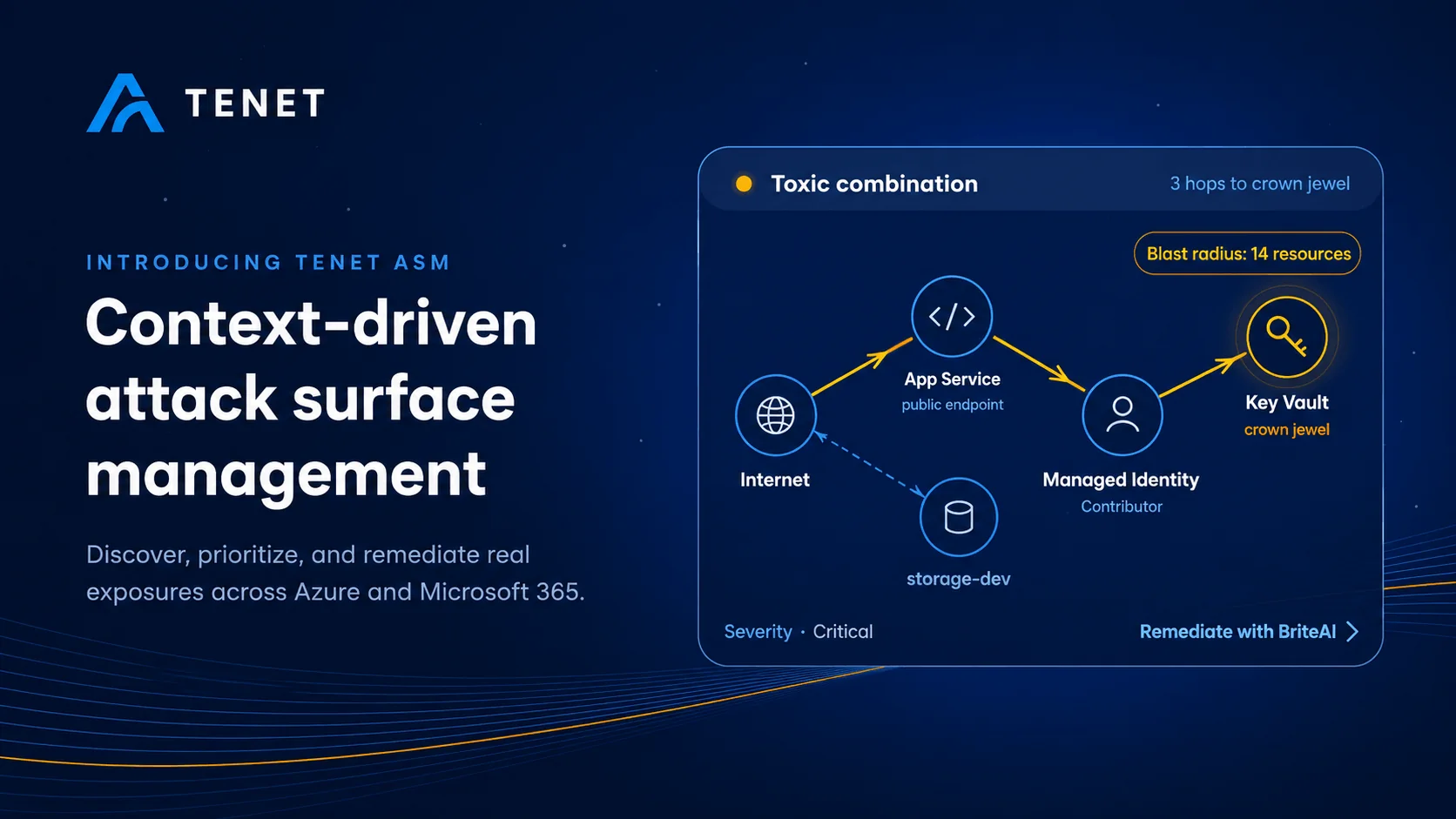
TENET’s attack path visualization helps teams analyze how exposed resources, identity relationships, permissions, and connectivity can combine into a lateral movement path. That matters because security teams rarely lose time on a single alert. They lose time trying to manually connect a chain of related risks across different tools.
By visualizing blast radius and path relationships, TENET helps teams focus on questions such as:
- Can this exposed asset lead to privileged access?
- Does this identity create a path toward admin permissions?
- Could a low-level issue become critical because it connects to crown-jewel data?
That is a more useful way to review exposure than scanning raw alert counts.
4. Prioritize toxic combinations, not just severity labels
One isolated issue does not always define the real risk. Often, business impact appears when multiple conditions exist together.
TENET is designed to highlight toxic combinations across Azure environments. For example, a finding becomes much more urgent when an internet-exposed workload is also tied to a highly privileged identity, weak access boundaries, or a path into sensitive systems.
This matters because many teams still prioritize based on severity in isolation. In practice, a medium issue plus another medium issue plus identity abuse potential can be more dangerous than a single critical alert with no meaningful blast radius.
TENET’s risk scoring approach is intended to help teams prioritize according to combined context, exploitability signals, and business consequence rather than volume alone.
5. Connect attack surface management to identity risk
In Azure, identity is often the fastest route from exposure to business impact. Service principals, managed identities, inherited permissions, stale access, and overprivileged accounts can quietly expand the blast radius of a visible exposure.
That is why attack surface management cannot stop at infrastructure discovery. TENET connects attack surface analysis with access governance so teams can discover and reduce identity-based attack paths alongside infrastructure risk.
This is especially important for organizations that want to answer questions like:
- Which exposed resources are tied to privileged identities?
- Where does standing access create avoidable risk?
- Which identities create unnecessary paths to sensitive data or control planes?
When identity context is included in attack surface analysis, remediation becomes more targeted and much more effective.
6. Support remediation with ownership and operational clarity
Attack surface management only creates value when teams can fix what they find. One of the most common reasons risks stay open is simple: the organization cannot quickly determine who owns the issue and what needs to change.
TENET’s broader risk intelligence model is built to support action, not just observation. By unifying signals into a single view, the platform helps teams move faster from detection to prioritization and remediation. Security teams can spend less time correlating alerts manually and more time routing the highest-impact issues to the right stakeholders.
That operating model matters. A smaller, contextualized queue of meaningful risks is more useful than a large stream of disconnected alerts.
7. Strengthen compliance with continuous exposure awareness
Attack surface capability also supports governance and compliance efforts. Many teams are expected to demonstrate continuous visibility into public exposure, access risk, and control gaps, not just perform occasional reviews.
TENET supports this by pairing attack surface analysis with compliance automation and evidence mapping across relevant control areas. That gives teams a better way to show not only that risks were detected, but also how those risks relate to governance expectations and remediation priorities.
For Azure organizations, that creates a practical bridge between security operations and compliance reporting. Instead of maintaining separate narratives for exposure management and audit readiness, teams can work from a more unified risk picture.
What this looks like in practice
For an Azure security team, TENET’s attack surface capability is most valuable when it helps compress time between discovery and decision.
Instead of asking every tool for a different answer, teams can work from one contextual model:
- What is exposed right now
- Which resources have the highest blast radius
- Where identity risk amplifies infrastructure risk
- Which attack paths can lead to sensitive assets
- Which issues should be fixed first to reduce real exposure
That is the shift from visibility to actionable risk reduction.
Why this matters now
Azure environments are becoming more dynamic, more integrated, and more identity-driven. The attack surface keeps expanding as organizations adopt more services, more automation, more APIs, and more AI-connected workloads.
In that kind of environment, raw discovery is not enough. Teams need context. They need prioritization. They need to understand relationships, not just findings.
TENET’s attack surface capability is valuable because it helps Azure teams move from fragmented signals to a clearer view of exposure, exploitability, blast radius, and remediation priority.
That is what makes attack surface management operationally useful. It is not about collecting more alerts. It is about understanding where attackers have real opportunities and reducing those paths before they turn into incidents.